Maybe it’s the stretching, the scent of sandalwood incense or the sound of ‘ommmm’ at the end of class, but there’s something about yoga that just makes us feel… better. Don’t you think?
Derived from the root word ‘yuj’ or ‘yoke’, meaning to join or unite together, the essence of yoga has always been about connecting to your true self, beyond the noise and distractions of everyday life. Throughout the entire history of yoga, we can see how yoga postures, pranayama techniques, meditation and the many other facets of the practice are intended to help improve body-mind wellbeing. The ancient pages of the Bhagavad Gita, the Hatha Yoga Pradipika and the Yoga Sutras of Patanjali are full of wisdom on how to rid the body of aches and pains, toxins and emotional suffering in order to make space for us to connect to our true self and feel that little bit better after each practice.
We know we feel generally feel better after practicing yoga though, but can any of us put our finger on exactly why that might be? Maybe it doesn’t matter, but if we want to know how to help ourselves feel mentally, emotionally and physically better, surely it’s worth delving more into the reasons.
In this article, we’ll explore how the various aspects of yoga such as breathing, moving, meditating and mindfulness all help us feel better, with plenty of science-based evidence to back it up, just in case you need convincing. Let’s dive in…
The power of me-time
For many of us, spending time alone doing something we enjoy is something that doesn’t always reach top of the priority list. While we know how vital it is to get on the yoga mat regularly, chores, children’s needs, work or pure tiredness can often become difficult obstacles to overcome. The benefits of moving past these obstacles and carving out the time to practice alone however, have some truly remarkable benefits. Moments of solitude within a yoga practice can offer valuable benefits for our mental health, such as ‘affective regulation’ – our ability to manage our emotional response to a situation (1), as well as supporting our sense of autonomy and allowing for self-reflection, which may help us feel more at peace within ourselves (2). Not making time for ourselves on the other hand, can easily lead to an increased risk of anxiety, depression and burnout, so whether it’s a 90 minute power yoga class or a ten minute meditation, making time for you is a known way to help yourself feel better (3).
Key takeaway: Carving out time to get on your mat helps regulate your emotions, allows for self-reflection, and can help prevent and even lessen burnout.
Try this class: Create space with Esther Ekhart | 23 mins
Feel good hormones
We know movement physically benefits the body but the specific movements within a yoga class have a profound impact on our mental health too. Research published on the National Institutes of Health platforms suggests that stretching can increase levels of serotonin, the ‘feel good’ happy hormone that makes us feel relaxed and calm (4). The research also shows that yoga triggers neurohormonal mechanisms that suppress sympathetic activity – or put simply, yoga helps take you out of ‘fight or flight’ mode and into a ‘rest and digest’ relaxed state (5).
When practiced even for a short amount of time in the middle of the work day, studies have shown that a regular practice is effective for calming anxiety, reducing pain and alleviating exhaustion (6), as well as positively impacting the structure and function of areas of the brain such as the hippocampus (linked to memory), amygdala (linked to processing emotions like anger and fear) and prefrontal cortex (connected to decision making) (7).
Key takeaway: Stretching in your yoga class can help increase levels of serotonin. Even a short daily practice can calm anxiety, alleviate exhaustion and positively impact several areas of the brain.
Try this class: Mood booster with Tashi Dawa | 33 mins
The calm effect
When we’re encouraged to practice mindfulness through yoga, the benefits can be carried far from the mat and into everyday life. From a brain-science perspective, mindfulness can increase cortical thickness, which enhances emotional regulation, resilience and a better ability to cope with pain (8). Mindfulness can also help us become more engaged with our daily life; helping us feel more present, and allowing for more moments of gratitude to arise, which helps improve our overall sense of wellbeing (9).
Today, with our constant connection to technology and social media, it can be all too easy to miss the life in front of us in favour of the artificial world on screen. By taking the mindfulness from your yoga practice into everyday life, it’s likely you’ll start to feel calmer, more able to regulate emotional responses, and even the ability to become more aware of your habits, so you can (if you want to) take steps to positively change them.
Key takeaway: Mindfulness helps us become more present in everyday life, can increase gratitude, promote calmness and help us become more aware of our habits.
Breathe yourself back into your body, with Sandra Carson
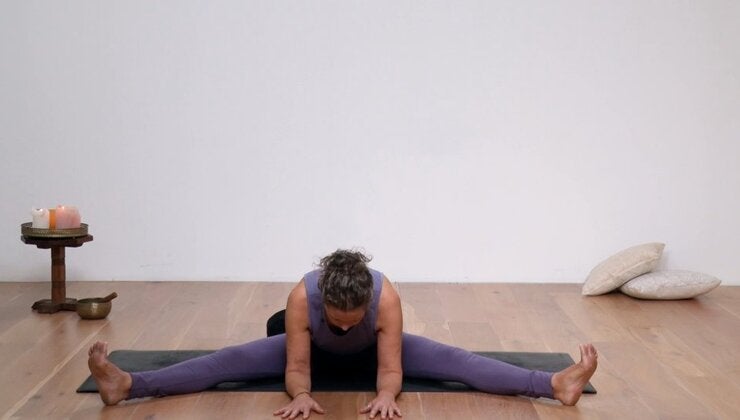
This class is perfect for winding down after a stressful day or for when you feel anxious. We will do a lot of gentle breath work to drop your presence into your body and into the moment. Your breath and your physical sensations will help you to lower stress and invite a calmer state of being. With Janu Sirsasana, Upavista Konasana, Balasana, Makarasana and more.
How pranayama changes our mood
Have you ever noticed yourself holding your breath when you’re stressed or anxious? Or that big sigh of relief after receiving a piece of good news? The way we breathe has a huge connection to how we feel, sending messages to the brain and body about how we should be feeling. When we breathe in a shallow, fast pattern, this sends messages via the vagus nerve to the brain that a stressful event is happening, which in turn encourages a release of cortisol and adrenaline.
When we slow down the breath however, this sends a message to the brain that everything is a-ok, and the nervous system can relax. Research into alternate nostril breathing (Nadi Shodhana) shows that when practiced consistently, can enhance the autonomic control of the heart by increasing the body’s parasympathetic response (10). The practice doesn’t have to take long either; these findings were the result of just a 5-minute daily practice over 6 weeks! When we look at how breathing through either nostril specifically benefits us, we can see that left nostril breathing (Chandra Bhedana) can improve heart rate variability and vagal tone, which all helps promote calmness (11). Alternatively, right nostril breathing (Surya Bhedana) can elicit more energised emotional states, increase focus and reduce anxiety-driven mind-wandering, which can be helpful if you’re prone to getting caught up in an anxious spiral of thoughts (12).
Key takeaway: Left nostril breathing can stimulate the parasympathetic nervous system (rest and digest), while right nostril breathing can help us feel more energised, alert and focused. Alternate nostril breathing (Nadi Shodhana) – when practiced for just 5 minutes per day – can elicit a relaxation response, helping us feel calmer more consistently.
Try this class: Feel grounded and cultivate focus with Andrew Wrenn | 15 mins
How sound and silence soothe the nervous system
You don’t need a scientific study to tell you it feels good to chant ‘Om’ or ‘Aum’, but we’re going to give it to you anyway… When we hum, sing, or chant – especially in a group environment where we feel relaxed – this can trigger a deep relaxation response that reduces anxiety and improves stress levels. A study on yoga practitioners chanting ‘Om’ for 5 minutes showed an enhancement of parasympathetic nervous system activity (rest and digest) (13) promoting calmness, as well as the physical benefits that relate to this state such as improved digestion, lowered blood pressure and less inflammation. Chanting has also been shown to reduce depressive symptoms and increase our sense of social cohesion (14), which we know is vital for overall mental wellbeing (15).
If your brain feels ‘busy’, spending time in silence in your yoga practice can help reduce the ‘mental load’ you might feel sometimes, as well as reducing stress and even enhancing creativity by stimulating new cells within the hippocampus of the brain.
As well as sound, the silence you may experience when practicing yoga can be a balm to the nervous system, which can become all too stressed amidst the noisiness of everyday life (traffic, the whirring of home appliances or noisy offices). Especially if your brain feels ‘busy’, spending time in silence in your yoga practice can help reduce the ‘mental load’ you might feel sometimes, as well as reducing stress and even enhancing creativity by stimulating new cells within the hippocampus of the brain (16). Being in a quieter environment also welcomes more self-reflection, which as we’ve mentioned, can help us become more aware of our emotions, habits and thoughts.
Key takeaway: Whether you’re chanting ‘Om’ or embracing silence, both of these practices can enhance a sense of relaxation. Chanting specifically helps improve our sense of community and connection and time spent in silence stimulates cells in the hippocampus of the brain to grow, improving memory and creativity.
Try this class: Chanting Om with David Lurey | 9 mins
Why doing ‘nothing’ is everything
Though it may not sound entirely relaxing to simply lie down on the floor with nothing more than a thin mat for support; after you’ve moved, breathed and ‘Om’-ed, the Savasana at the end of a yoga practice can feel like floating on a cloud. Often, you may be guided through a deep relaxation practice to help you drift off into a state of peace, and as the name suggests, this can indeed be deeply relaxing for the nervous system. As well as feeling emotionally relaxed, a guided deep relaxation practice can physically lower stress hormones such as cortisol and adrenaline, paving the way for a more balanced hormonal state (17). Deep relaxation techniques can also trigger the release of oxytocin, named the ‘love hormone’, which can help us feel socially connected and less anxious (18). Leaving your mat and returning to daily life in a calmer and more connected state means you’re also more likely to foster positive relationships with those around you, feel more tolerant, and feel more loving towards those around you (19). Chances are, if you’re feeling better after your yoga practice, you’ll help others feel better too!
Key takeaway: Make the most of your time to relax deeply at the end of your yoga class. This part of the practice can encourage the release of hormones like oxytocin – our ‘love’ hormone – as well as decreasing stress hormones like cortisol. When you feel better, you may just help others around you feel better too.
Try this class: Soothing Savasana with Paula Hines | 19 mins